
What counts as an elopement in Tuscany?
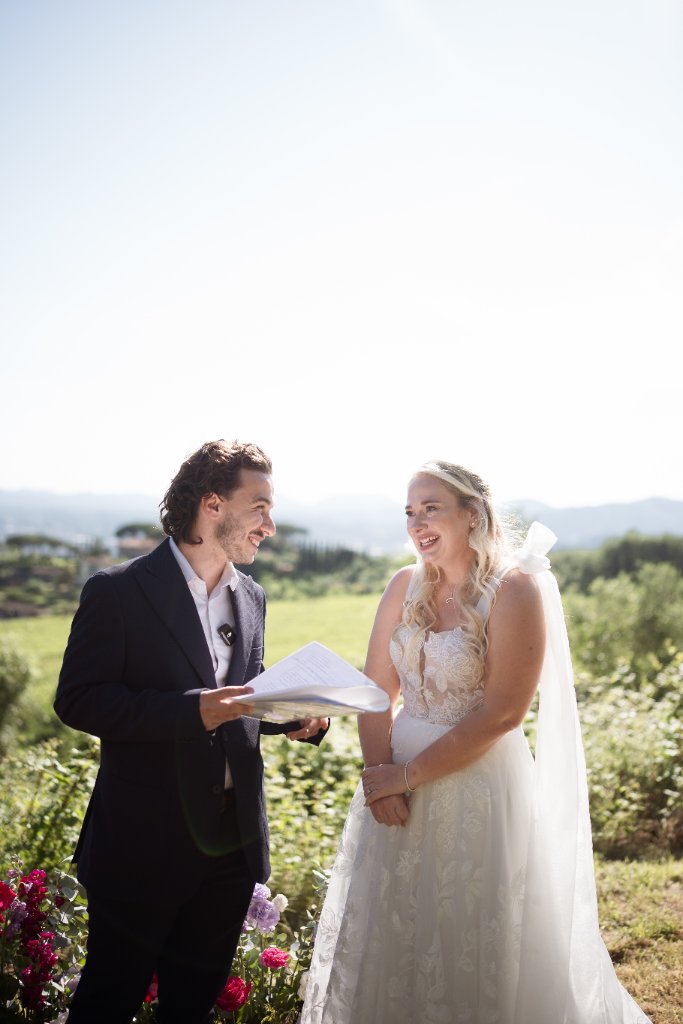
An elopement is a small, intimate ceremony — most often just the two of you, sometimes a handful of closest people — without the production of a full wedding. In Tuscany that usually means a symbolic ceremony on a vineyard terrace, a hilltop, or in a walled garden, with a photographer and a celebrant and not much else. The line between an elopement and a micro-wedding is loose; what matters is the scale and the feel, not the word.
How to elope in Tuscany — step by step
The process is simpler than a full wedding, but the order matters. 1. Decide legal or symbolic. Most elopements I lead are symbolic, which means no Italian civil-marriage paperwork is attached to the ceremony itself and the legal marriage is handled separately. 2. Choose the area. Val d'Orcia for the iconic views, Chianti for vineyards, Florence for a city ceremony, Siena or San Gimignano for medieval backdrops, Lucca for an easy walled-town setting. 3. Choose the venue. Many Tuscan estates welcome small ceremonies without requiring a full event buy-out. 4. Choose a celebrant. I write and deliver the ceremony; for an elopement this is often done remotely in advance, then I travel in for the day. 5. Book a photographer. For a Tuscan elopement the photographer is the other essential vendor - the landscape is half the point. 6. Sort the logistics. Travel, access, any venue or location permissions that apply, and a realistic timeline for the day.
Legal vs symbolic elopement
A legally binding elopement in Tuscany still follows the Italian civil process, with requirements that depend on your nationality, circumstances, and the comune involved. A symbolic elopement has no Italian marriage paperwork attached to the ceremony itself, so you can complete the legal marriage separately and come to Tuscany for the ceremony you actually want. The symbolic vs civil guide covers the difference in full.
Can foreigners elope in Tuscany?
Yes, international couples can elope in Tuscany. If the ceremony is symbolic, there is no Italian marriage paperwork attached to the ceremony itself, which is why this route is so simple for couples travelling from abroad. If you want the elopement to be legally binding in Italy, the civil requirements depend on your nationality, circumstances, and the comune involved. The official interpretation and documentation page covers the specialist support for that route.
Best places to elope in Tuscany
Tuscany's strength for an elopement is variety within a small area — you can drive between very different settings in under an hour. These are the places couples elope to most.
Val d'Orcia
The postcard Tuscan landscape — rolling hills, isolated cypress, stone farmhouses. It's quieter and more rural than Chianti, and the view alone carries the ceremony. Best at golden hour.
Chianti
Vineyard estates between Florence and Siena, with tasting rooms and cypress lines. Best for couples who want the wine-country feel and a ceremony among the vines, often with a tasting or lunch after.
Florence
Rooftop terraces, hidden piazzas, and Renaissance backdrops — a city elopement with everything walkable. Best for couples who want culture and a ceremony in one. The Florence celebrant page covers settings.
Siena
Medieval brick lanes and a countryside minutes away. Couples often elope on an estate just outside the city and spend the evening in Siena itself — quieter than Florence, just as atmospheric.
San Gimignano
Towers rising above the hills — the most iconic small-town elopement backdrop in Tuscany. The San Gimignano celebrant page covers it.
Lucca
A flat, walkable walled city — one of the easiest Tuscan towns for an elopement, with ceremony settings inside the walls. The Lucca celebrant page covers it.
Eloping just the two of you
Most Tuscan elopements are the couple and no one else, and that's where the format is at its purest. A short ceremony, a photographer, a long lunch, and the landscape — no schedule but your own. A 10-to-15-minute ceremony is usually enough; the day is about being there together rather than performing for a room.
Small elopements with guests
An elopement with a handful of guests — five, ten, or fifteen — is increasingly common. The ceremony stays intimate, but you add a meal, a few readings, and sometimes a small ritual. The line between this and a micro-wedding is thin; the intimate micro-wedding guide goes deeper on that scale.
Typical Tuscany elopement timeline
A Tuscan elopement day usually runs lighter than a wedding day. A common shape is a relaxed morning, getting ready in the afternoon, then a late-afternoon ceremony followed by portraits as the light softens and a long dinner. In midsummer, starting later can make a big difference to heat and photography. Because there is no large guest list to manage, the day can bend around the light and the venue rather than a rigid run sheet.
Vendors you actually need
For a Tuscan elopement the essential list is short: a celebrant, a photographer, and the venue. Beyond that, a hair-and-makeup artist is the next most common addition, and a florist for a small bouquet. Catering is usually the venue's restaurant or a nearby trattoria rather than a hired caterer. That's often the whole list — the simplicity is part of the point.
Best months for a Tuscany elopement
Late spring (May-June) and early autumn (September-October) offer the best light and mild temperatures for an outdoor ceremony. Summer works too, but expect heat in July and August, especially midday. May and October are my preferred months for a Tuscan elopement — quieter, cooler, and the light at its best. For the month-by-month detail, the best time to marry in Italy guide covers it.
Choosing a venue
Tuscany's strength is variety within a small area. Vineyard estates in Chianti, hilltop gardens over the Val d'Orcia, and medieval borgo courtyards near Siena and Florence all suit an elopement, since most welcome small groups without requiring a full-scale event.
Logistics for two (or a few)
Most elopements need far less coordination than a full wedding: a venue, a photographer, and a celebrant to write and deliver your ceremony. I handle the ceremony design and script entirely remotely before flying in to officiate, so you can focus on the venue and photography.
A typical structure
A short, personal script of 10-15 minutes works beautifully for two people. Vows, a ring exchange, and perhaps one meaningful reading or ritual, without the pacing needs of a larger guest list.
Sample symbolic elopement ceremony structure
An elopement ceremony is a compressed version of a full symbolic ceremony — the same shape, less padding. A typical structure: Welcome. A few warm lines to set the tone — even with no guests, this marks the moment. Your story. A short telling of how you met and why you're here, written from our conversations. Vows. Your promises to each other — written yourselves, or repeated after me. Ring exchange. The rings, with a line each or in silence. A ritual (optional). A handfasting or a shared cup works especially well for two. Pronouncement and close. The line that ends the ceremony and lets the day begin. The whole thing runs 10 to 15 minutes — long enough to feel real, short enough to leave the rest of the day for the two of you. The ceremony script example shows the fuller version, and the symbolic rituals guide covers the rituals that suit a small ceremony.