
Why Tuscany
Tuscany earns its reputation honestly. The light sits at the right angle for a wedding photograph for most of the year; the landscapes — vineyards, cypress lines, stone walls — do most of the work the venue otherwise would; and even in peak season, the right estate gives you the feel of a private hillscape rather than a busy wedding-farm venue. This is where couples keep coming to marry in Tuscany across the broadest range of styles and budgets.
Where to marry in Tuscany
Vineyards. Rows of vines and a tasting-room reception — the working Tuscan estate at its best. Farmhouses (agriturismo). Restored stone farmhouses are the natural shape for a 30-to-150-guest wedding; the central courtyard is the ceremony. Lucca. Inside the walls; an intimate, walkable town for almost any size. Pisa. For couples wanting both city and coast within easy reach. San Gimignano. Medieval towers rising above the hills — for couples who want iconic. Florence. Renaissance architecture and rooftop terraces; small to medium ceremonies work better here than very large ones. A personal note on planning: the destination wedding planner in Tuscany I know best is Efffetti, founded by my mother Francesca. I grew up around her work, and she taught me almost everything I know about how an Italian wedding day actually comes together - not only the ceremony, but the timing, suppliers, guests, paperwork, and all the small decisions behind it.
How to get married in Tuscany — step by step
The process is more linear than couples expect once you separate the legal part from the celebration. In practice: 1. Decide between a legal or symbolic wedding. Most international couples choose a symbolic ceremony in Tuscany and handle the legal marriage at home, which removes the paperwork from the Italian side entirely. 2. Choose the area of Tuscany. The region is broad — Florence, Chianti, Siena, Val d'Orcia, San Gimignano, Lucca, and Pisa each have a different feel. The areas section below breaks them down. 3. Choose the venue. A vineyard estate, a restored farmhouse, a palazzo, or a walled-town venue — the area usually narrows this. 4. Choose the celebrant or officiant. This is the part that shapes the ceremony itself; the Tuscany celebrant page covers what's included. 5. Handle legal paperwork if applicable. If you're marrying legally in Italy, the documents and translations need to start months ahead; the official interpretation page covers that side. 6. Design the ceremony. The script, readings, vows, and any ritual — built around your story. 7. Coordinate the ceremony with your planner or venue. I manage the ceremony timing, cues, readers, music moments, and flow on the day so you can stay focused on the moment itself.
Can foreigners get married in Tuscany?
Yes, foreign couples can legally marry in Tuscany. The exact process depends on your nationality, your personal circumstances, and the comune where the civil marriage will take place, so there is no single paperwork list that applies to everyone. A legal Italian marriage may involve civil-status or consular documents, translations, legalisation, and appointments before the wedding. Many international couples I work with choose the simpler alternative: a symbolic ceremony in Tuscany and a legal signing at home.
Legal vs symbolic wedding in Tuscany
A legally binding wedding in Tuscany follows the civil rules of the relevant comune, including the applicable venue, document, language, interpretation, and ceremony requirements. A symbolic wedding does not create a civil registration, so it gives you much more freedom over the setting, language and structure while you handle the legal marriage separately. The deeper comparison is in the symbolic vs civil guide; in Tuscany, that flexibility is what makes vineyard terraces, private gardens and other non-civil settings possible for the symbolic ceremony, subject to venue and local rules.
Getting married in Tuscany as an American
American couples can legally marry in Tuscany, but the exact documents and appointments depend on the current requirements of the relevant Italian authorities and your circumstances. If you want the legal marriage to take place in Italy, start early and verify the process for the specific comune rather than relying on a generic checklist. If you prefer to avoid Italian civil paperwork, a symbolic ceremony in Tuscany lets you complete the legal marriage in the US and keep the Italian day entirely personal. The official interpretation and documentation page explains where to get specialist support.
Getting married in Tuscany as a British couple
British couples can also marry legally in Tuscany, but the required documents and procedure depend on the current UK and Italian rules, as well as the comune handling the marriage. For that reason I would not treat any online checklist as universal. If you want a legal Italian ceremony, confirm the paperwork early and use specialist support for interpretation, translations, and liaison with the comune where needed. If you prefer a simpler route, you can marry legally in the UK and hold a fully personal symbolic ceremony in Tuscany. The official interpretation and documentation page covers the legal-service side.
Best areas of Tuscany for a destination wedding
Tuscany is broad, and the area you choose changes the feel of the day more than the venue does. The areas below are the ones couples return to most.
Florence
Renaissance architecture, rooftop terraces, and a walkable city centre — best for small to medium ceremonies and couples who want a city as well as a landscape. Spring and autumn suit it best; July and August are hot. The Florence celebrant page covers settings and timing.
Chianti
The vineyard heart of Tuscany, between Florence and Siena — working wine estates with tasting-room receptions, cypress lines, and the classic Tuscan postcard view. Best for couples who want the wine-country feel and a ceremony among the vines.
Siena
A medieval city of brick and shadowed lanes, with the countryside minutes away. Couples often marry on an estate just outside Siena and celebrate in the city — the best of both, with fewer crowds than Florence.
Val d'Orcia
The iconic Tuscan landscape — rolling hills, isolated cypress, stone farmhouses, and the light photographers love. It's quieter and more rural than Chianti, and the view does most of the work the venue would.
San Gimignano
A medieval skyline of towers rising above the hills — the most iconic small-town setting in Tuscany. Best for couples who want a recognisable backdrop and a walkable walled town. The San Gimignano celebrant page covers it.
Lucca
A walled city you can walk around, intimate and flat — one of the easiest Tuscan towns for guests, with ceremony settings inside the walls. The Lucca celebrant page covers it.
Pisa
For couples who want city and coast within easy reach — Pisa sits close to the Tuscan coast, which makes a beach or seaside element possible alongside a city ceremony. The Pisa celebrant page covers it.
Best time of year for a Tuscany wedding
May and late September into early October are the sweet spots: warm, golden, and quieter than summer. July and August carry Tuscan heat (the right estate makes this part of the romance); November through February suits covered venues — fireplaces and candle-light Tuscan style. June is wonderful but the most-booked month of the year. For the month-by-month detail, the best time to get married in Italy guide goes deeper.
How far in advance should we plan?
For a summer or September wedding in Tuscany, 12 to 18 months is the safe window for the best venues and dates — June and September book fastest. For a spring or late-autumn wedding, 6 to 12 months is usually enough. Elopements can come together in 3 to 6 months, especially outside peak season. The celebrant is worth booking early, because the date and the ceremony both depend on it.
What does a wedding celebrant do in Tuscany?
A celebrant in Tuscany designs and writes the ceremony, leads it on the day, and handles the flow so you don't have to — the same role as anywhere, but shaped by the landscape: writing for a vineyard terrace or a walled garden rather than against it. Because I work across Tuscany regularly, travel within the region is included in the fee. The Tuscany celebrant page covers what's included and the pricing page sets out the fee.
The ceremony in a Tuscan setting
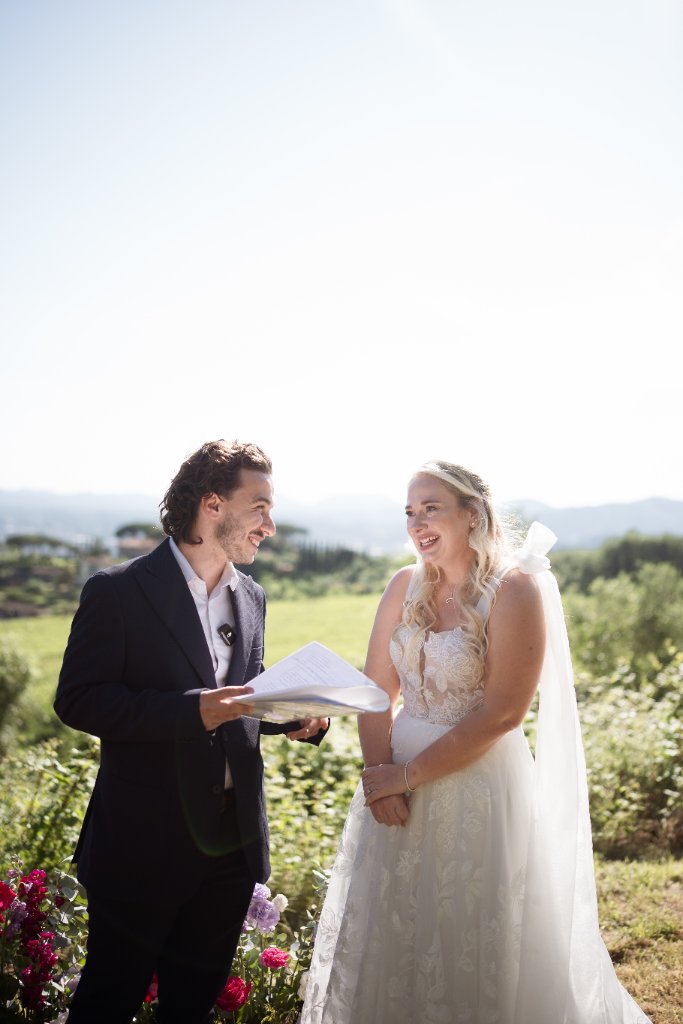
A Tuscan ceremony tends to lead with the place — the cypress line, the vineyard terrace, the open courtyard — and the script sits inside that frame. I lead these often; a celebrant in Tuscany's everyday job is writing for the landscape, not against it.
Plan your Tuscan ceremony
Tell me which version of Tuscany you're drawn to and we'll shape the ceremony to fit. San Gimignano and Florence each have their own pages; look first at where the day actually lives for you, and we'll write the ceremony for that place.