Why Puglia works for a ceremony
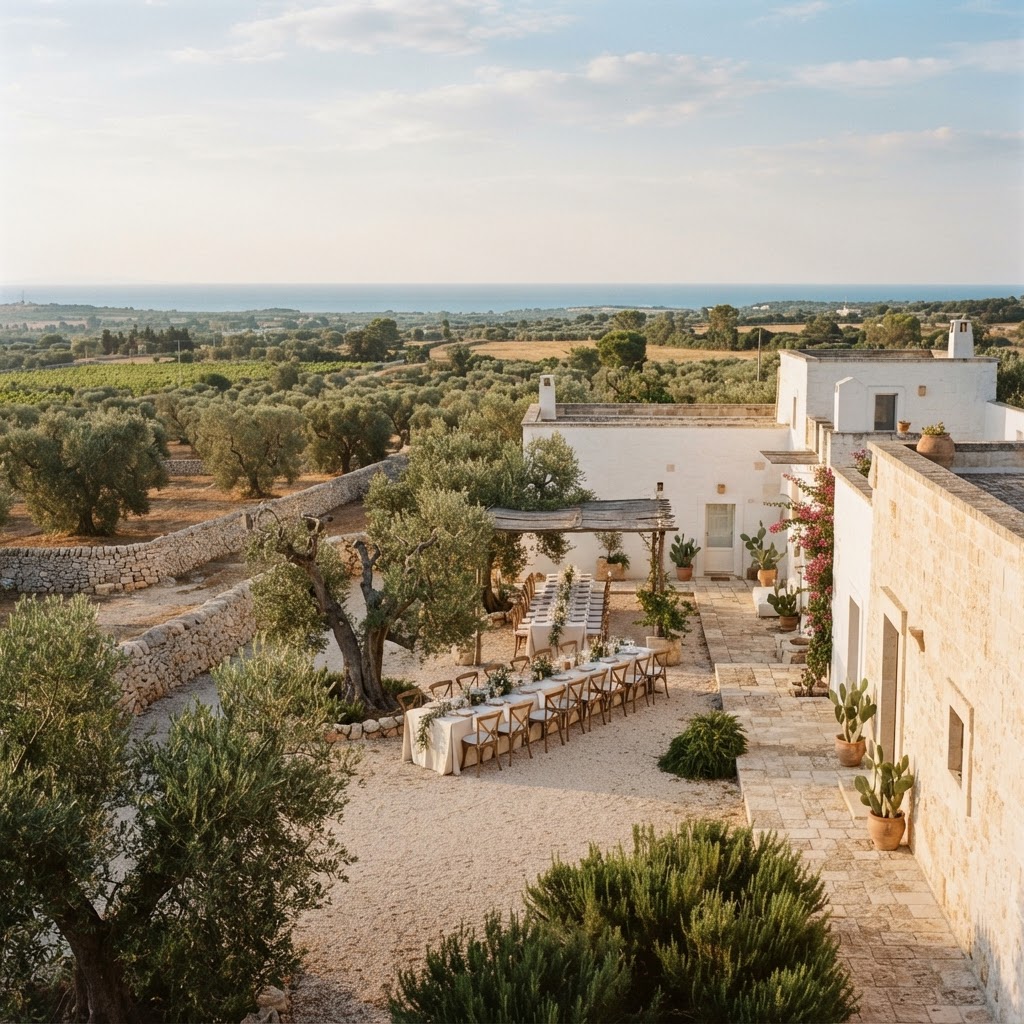
Puglia is the part of Italy that still feels undiscovered at the right hour. Whitewashed masserie standing in olive groves, trulli with their dry-stone cones, fishing towns on two seas, and light that stays golden for most of the afternoon. For a ceremony, the appeal is space: you are rarely competing with another wedding, and the landscape itself is the decoration. It suits couples who want warmth, food, long tables and a setting that feels southern and generous rather than formal. It is also one of the best value regions in Italy for a wedding, which matters when the guest list has to fly in.
Where in Puglia
The Valle d'Itria is the classic choice: Ostuni, Locorotondo, Cisternino and Martina Franca, a plateau of trulli, almond trees and white towns where most masserie weddings happen. The Salento, the southern peninsula, is the other pole: Lecce with its baroque stone, Otranto and Santa Maria di Leuca on the sea, and long stretches of coastline for a ceremony at sunset. It is hotter, more Mediterranean, and better for a beach or cliff setting. The Gargano, in the north, is greener and wilder, with the Foresta Umbra and the Tremiti islands offshore. Matera, just over the border in Basilicata, is close enough to pair with a Puglia week and has one of the most extraordinary ceremony settings in Italy.
The best time of year
April to June and September to mid-October are the sweet spots: warm but not punishing, with the olive groves at their best and the coast still quiet. May is probably the single best month for a Puglia ceremony. July and August are hot, often above 35 degrees by early afternoon, and the coast fills with Italian holidaymakers. If you want those months, plan the ceremony for early morning or the last hour before sunset and give guests shade and water. Winter is mild and inexpensive, and a masseria with a fireplace in November is genuinely lovely, though some coastal venues close. The month-by-month guide to marrying in Italy compares the regions side by side.
Ceremony settings that work
A masseria courtyard is the most Puglian option: white stone walls, an old oven, an olive tree in the middle, and shade at the right time of day. It handles heat better than open ground and needs almost no decoration. Trulli gardens and dry-stone terraces give the postcard image, and they photograph beautifully at golden hour. Sea terraces in the Salento give you the Adriatic or the Ionian as a backdrop, with the wind as the only real variable. Olive groves are quieter and more private, and work well for elopements of two to twenty guests. If you want a larger ceremony, the intimate and micro-wedding guide explains why smaller rooms often produce better ceremonies.
Getting there and moving around
Bari and Brindisi are the two airports, and both have direct flights from much of Europe. From Bari, the Valle d'Itria is under an hour; Brindisi puts you close to the Salento. Matera is roughly an hour from Bari airport. The practical issue is that venues are spread out and public transport is thin. Guests will need transfers or cars, and the distances between a masseria, a beach and a town are longer than they look. Build the shuttle into the budget early, and keep the ceremony within fifteen minutes of where everyone is staying if you can.
Legal or symbolic in Puglia?
A symbolic ceremony in a masseria, a trullo garden or an olive grove carries no Italian civil-marriage paperwork, which is exactly why those settings are possible. Most international couples I marry in Puglia complete the legal marriage at home and treat the Puglian ceremony as the celebration. A legal marriage in Italy follows the rules of the local comune, requires documents from your own country and is celebrated in Italian by the town's official. The symbolic vs civil guide sets out the difference clearly, and the foreigners' paperwork guide covers the documents if you want the legal route.
What the ceremony feels like here
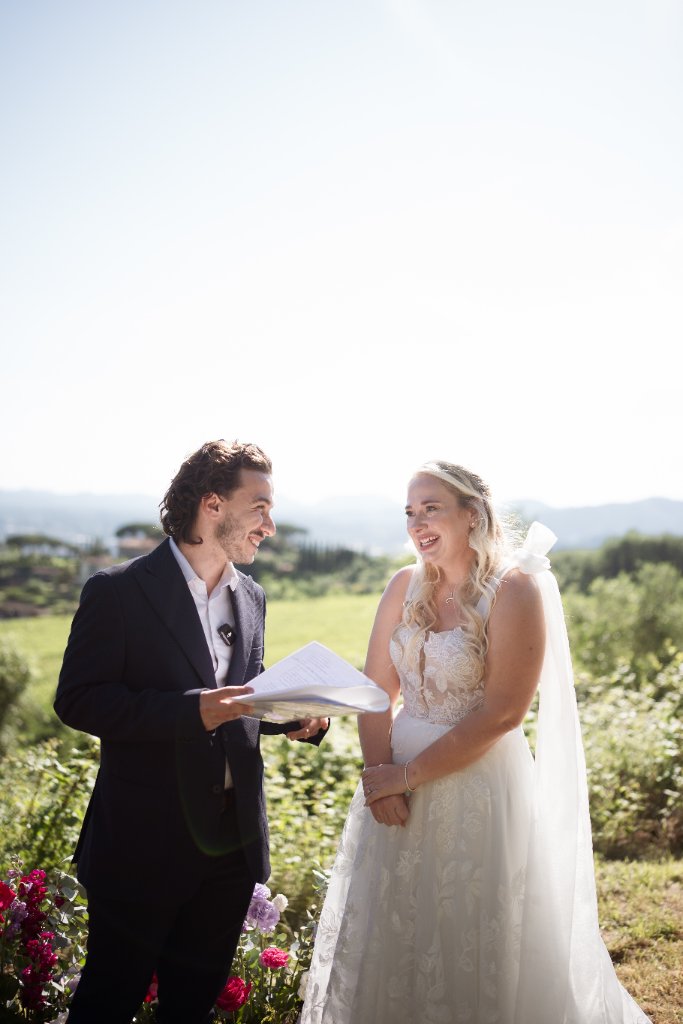
Puglian ceremonies tend to be warm and unhurried. The heat slows everything down in a good way, guests are relaxed, and the light does most of the work. I keep the structure simple: a welcome that acknowledges how far people have travelled, your story told properly, vows, one ritual if you want one, and a closing that leads naturally into aperitivo. Local touches land well here: an olive branch, a Pizzica played as you leave, a few words in Italian for the family. The symbolic rituals guide has options that suit an outdoor southern setting.
Plan your Puglia ceremony
Tell me the month, roughly where in Puglia you are drawn to, and how many guests you imagine, and I will show you how the ceremony could flow around the heat and the light. Puglia is outside my home region, so travel and accommodation are quoted separately. You can check availability here.