The word means two different things
If you are American, a wedding officiant is the person with the legal power to marry you: a minister, a judge, a friend ordained for the day. In Italy that power does not work the same way. The authority to marry belongs to the state, and it is exercised by an official of the comune, not by a private person you choose. So when couples search for a wedding officiant in Italy, they are usually looking for one of two very different things: the official who performs the legal act, or an English-speaking celebrant who designs and leads a personal ceremony around their story. Most destination weddings I work on need the second, and many also arrange the first separately. Knowing which one you are booking saves a lot of confusion.
Who legally marries you in Italy
A marriage that is legally valid in Italy is celebrated by the ufficiale dello stato civile, which in most towns means the mayor or a councillor delegated by the mayor, sometimes a registrar. The ceremony takes place at the town hall, or in some comuni at an authorised venue, and it is conducted in Italian, with two witnesses and a fixed formula that leaves little room for personalisation. Foreign couples can marry this way, but the paperwork comes first: a nulla osta or certificate of no impediment from your own country, translations, and appointments that depend on the comune. The guide to marrying in Italy as a foreigner walks through the documents, and the symbolic vs civil comparison explains when the legal route is worth the effort.
What an English-speaking celebrant does
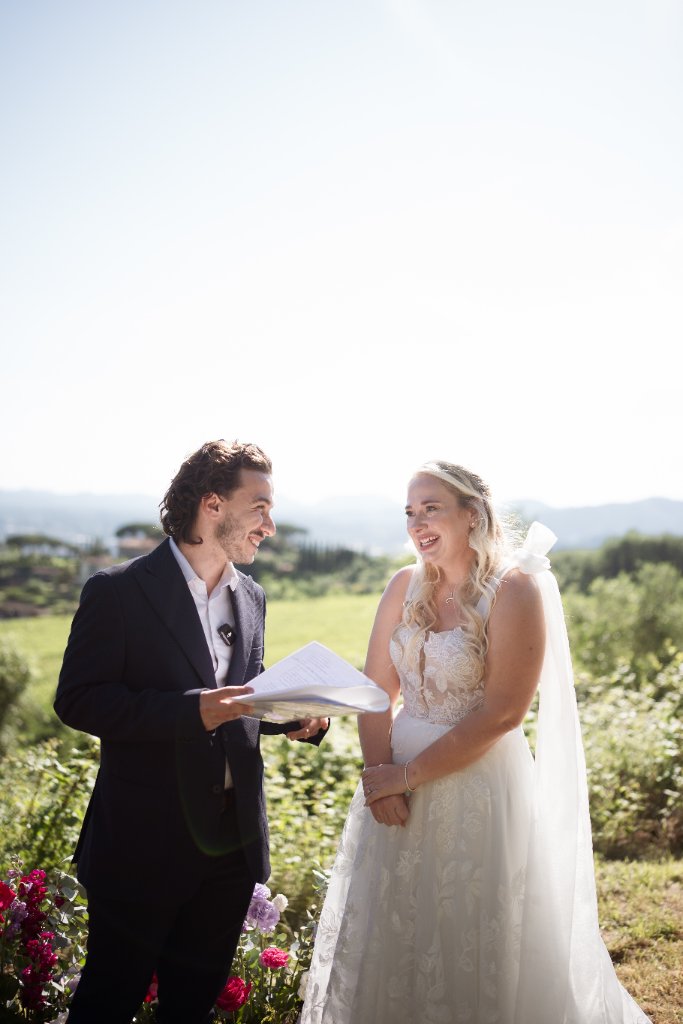
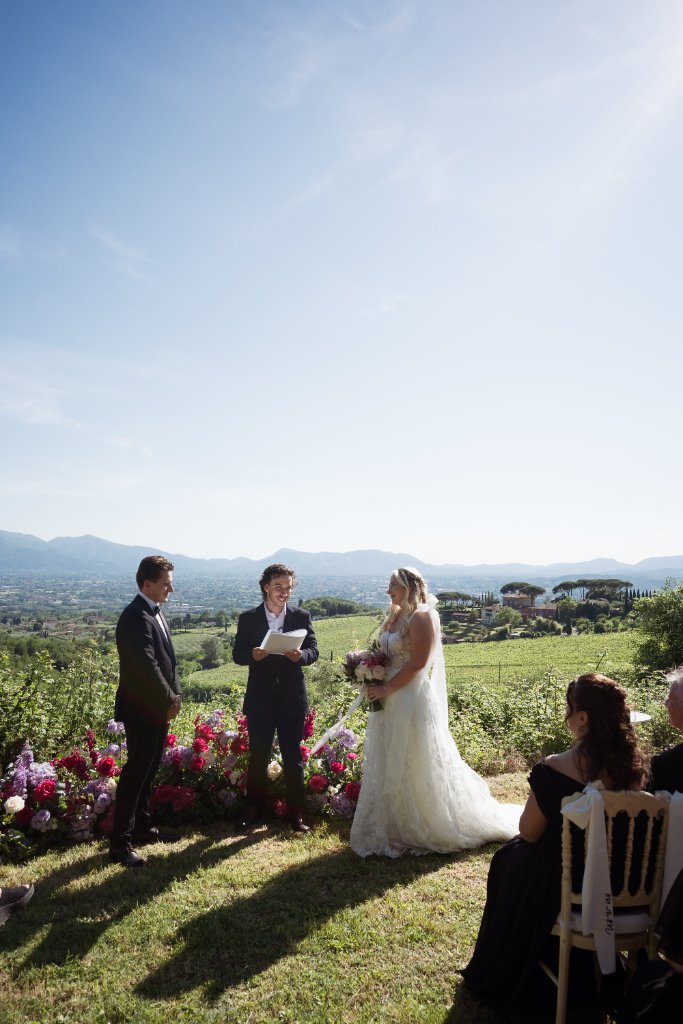
A celebrant leads a symbolic ceremony, which has no legal effect but is where the emotion of the day actually lives. The work starts weeks or months earlier: a conversation about how you met, what you want the room to feel like, who should speak, which readings belong, whether you want a ritual, and how the ceremony should end. On the day I arrive early, brief the musicians and the venue, keep the timing honest, and hold the ceremony itself: the welcome, your story, the words about the two of you, your vows, the rings, the closing. Bilingual ceremonies are common, since one side of the family is often Italian, and the bilingual ceremony guide covers how to keep both languages natural.
Where an officiant can work
Because a symbolic ceremony is not bound to an approved civil venue, the setting is limited only by the venue's own rules. I have led ceremonies in masseria courtyards, olive groves, villa gardens, castle terraces, abbey cloisters, on beaches and on boats. That freedom is the main reason couples choose this route: the place you fell in love with stays the place you get married, instead of a town hall room that could be anywhere.
Officiant, celebrant, planner, interpreter: who does what
These four roles get mixed up constantly, and the mix-up is expensive when it happens at the last minute. The officiant or celebrant leads the ceremony and writes it. The planner runs the day: suppliers, timings, seating, the hundred details around the ceremony. The interpreter translates, and for a legal wedding in Italy this is not optional in practice: an authorised interpreter is often required so that both of you understand what you are agreeing to. I work alongside planners regularly, and I am happy to coordinate with yours rather than replace them. If you are marrying legally in Italy, the interpretation and legal documentation page explains how that part fits.
Questions to ask before you book an officiant
A good officiant will welcome these, and the answers tell you most of what you need to know. Do you write every ceremony from scratch, or work from templates? Can I read a full sample script before I commit? Will we have more than one conversation before the wedding? Who runs the rehearsal, and is it included? What happens if you are ill on the day? Do you speak both our languages well enough to officiate in them, or will you need a separate interpreter? For a longer checklist, the guide to choosing a wedding celebrant in Italy goes through what separates a strong ceremony from a competent one.
What it costs
Officiant fees in Italy vary with experience, travel, the number of languages and how much writing is involved. A simple elopement ceremony is a smaller piece of work than a full bilingual wedding with a rehearsal and a large guest list, and the quote should reflect that honestly. The pricing page shows how I structure fees, and the symbolic wedding cost guide puts the celebrant inside the wider budget so you can see where the money actually goes.
Plan your ceremony
If you are still deciding between a legal town hall marriage and a symbolic ceremony in the place you love, tell me the date you have in mind and the region, and I will tell you honestly which route fits your situation. You can check availability here.